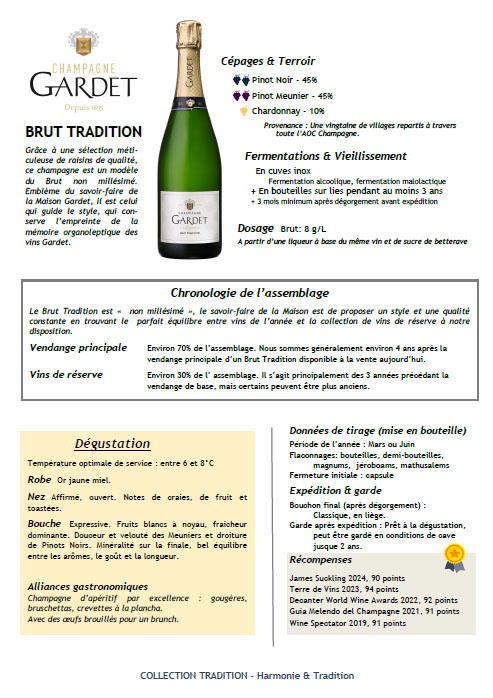






































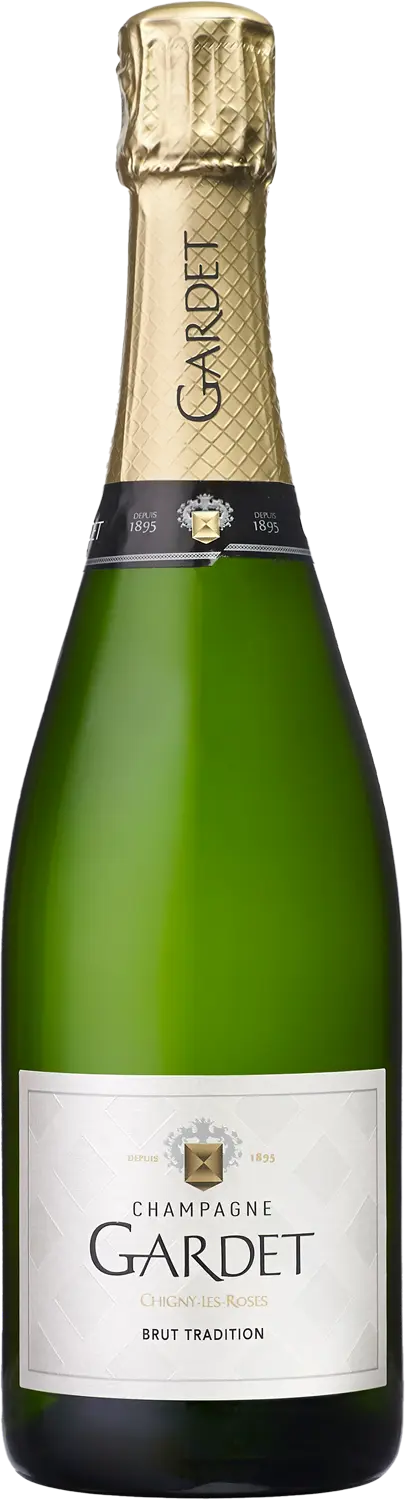
BRUT TRADITION
Best-seller
The iconic Gardet cuvée, a model non-vintage Brut. 45% Pinot Noir + 45% Meunier + 10% Chardonnay, ~20 villages across AOC Champagne. At least 3 years on lees, Brut dosage 8 g/L.
Vintage
NV · Non-vintage
Grape varieties
10% Chardonnay,
45% Pinot Noir,
45% Pinot Meunier
Dosage
Dosage Brut: 8 g/L, from a liquor made out of the same wine and beet sugar.
Aging
Three years of patience on the lees
1
Price case
(delivery included):
€143
Composition
Grapes & Origin
Pinot Noir · 45% · structure and drive
Pinot Meunier · 45% · roundness and velvet texture
Chardonnay · 10% · mineral tension
Origin: some twenty AOC Champagne villages, a plot-by-plot selection renewed each year for continuity of style.
Fermentations & Ageing
Stainless steel first, clean and unadorned: alcoholic fermentation, malolactic fermentation, no oak.
+ Then the bottle. Three years on the lees, in the cool chalk of our cellars at Chigny-les-Roses.
+ And at least three months after disgorgement: we let the liqueur breathe before it leaves.
Dosage
Dosage Brut: 8 g/L, from a liquor made out of the same wine and beet sugar.
Timeline of the bottle
Production timeline
Timeline of the bottle. Brut Tradition is a non-vintage; the House's know-how consists in offering a constant style and quality by reaching the perfect balance between the year's wines and a collection of reserve wines kept for this purpose.
Main harvest
Main harvest, about 70% of the blend: the most recent crop, generally around four years old at release. It brings the tension, the primary fruit, the acid freshness that sets a non-vintage Brut apart from a single vintage.
Reserve wines
Reserve wines, about 30% of the blend: mainly from the three years preceding the base harvest, some lots older. They carry the House identity: the mineral line, the brioche notes of long ageing, the roundness on the palate.
Tasting
Tasting
A reference point for anyone placing the Brut style of Champagne. The balance between the year's wines and reserve wines sets the benchmark: Pinot Noir tension, Meunier roundness, the Chardonnay's mineral line.
Optimal serving temperature
6 to 8 °C (43 to 46 °F)
Colour
Honey gold yellow
Nose
First nose on chalk and white stone fruit. Behind it, the brioche of lees ageing and a touch of vanilla. Underneath, restrained toasted notes.
Taste
On the palate, freshness leads. Then come the white stone fruits, the velvet of Meunier, the directness of Pinot Noir. The finish returns to the chalk of our cellars, and lingers.
Fine cuisine pairings
By nature a Champagne for an aperitif: gougères, bruschettas, grilled prawns. With scrambled eggs for a brunch.
Bottling & cellaring
Bottling data
Bottling period: March or June.
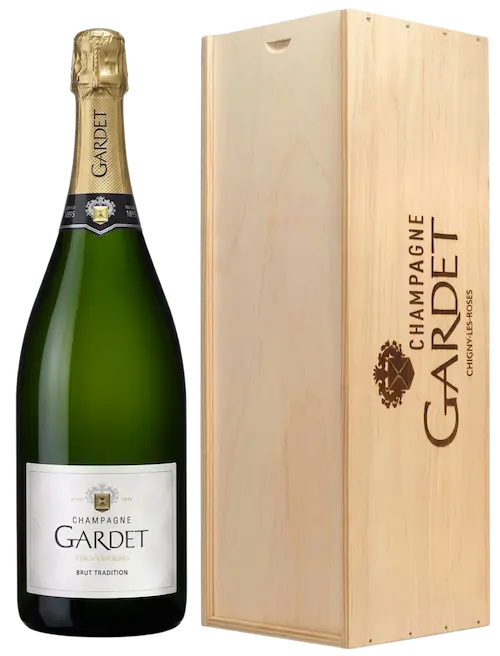
Container sizes: bottles, half-bottles, magnums, jeroboams, methuselahs, nebuchadnezzar.
Initial closure: crown cap.
Shipping & cellaring
Final cork (after disgorgement): classic cork.
Post-shipment cellaring: ready to drink, can be kept in cellar conditions for up to 2 years.
Awards
James Suckling 2026 · 92 points
Terre de Vins 2023 · Top 100 Best NV, 94 points
Decanter World Wine Awards 2022 · 92 points
Guia Melendo del Champagne 2021 · 91 points
Wine Spectator 2019 · 91 points
Five international voices for a cuvée that earns its recognition with every blend.
Available formats
Click a format to see all price tiers · United Kingdom (based on your delivery address)
75cl · Bottle
€143 / case
Shipping
Quantity tiers (net/bottle)
From 6 bottles
€---,-- / bottle
From 120 bottles
€---,-- / bottle
From 240 bottles
€---,-- / bottle
From 480 bottles
€---,-- / bottle
Pickup at Gardet
13 rue Georges Legros · 51500 Chigny-les-Roses
From 6 bottles
€---,-- / bottle
37.5cl · Half bottle
€182 / case
Shipping
Quantity tiers (net/bottle)
From 12 bottles
€---,-- / bottle
From 120 bottles
€---,-- / bottle
From 240 bottles
€---,-- / bottle
From 480 bottles
€---,-- / bottle
Pickup at Gardet
13 rue Georges Legros · 51500 Chigny-les-Roses
From 12 bottles
€---,-- / bottle
150cl · Magnum
€138 / case
Shipping
Quantity tiers (net/bottle)
From 3 bottles
€---,-- / bottle
From 120 bottles
€---,-- / bottle
From 240 bottles
€---,-- / bottle
From 480 bottles
€---,-- / bottle
Pickup at Gardet
13 rue Georges Legros · 51500 Chigny-les-Roses
From 3 bottles
€---,-- / bottle
3L · Jeroboam
€148 / box
Shipping
Quantity tiers (net/bottle)
From 1 bottle
€---,-- / bottle
From 120 bottles
€---,-- / bottle
From 240 bottles
€---,-- / bottle
From 480 bottles
€---,-- / bottle
Pickup at Gardet
13 rue Georges Legros · 51500 Chigny-les-Roses
From 1 bottle
€---,-- / bottle
6L · Methuselah
€271 / box
Shipping
Quantity tiers (net/bottle)
From 1 bottle
€---,-- / bottle
From 120 bottles
€---,-- / bottle
From 240 bottles
€---,-- / bottle
From 480 bottles
€---,-- / bottle
Pickup at Gardet
13 rue Georges Legros · 51500 Chigny-les-Roses
From 1 bottle
€---,-- / bottle
15L · Nebuchadnezzar
€988 / box
Shipping
Quantity tiers (net/bottle)
From 1 bottle
€---,-- / bottle
From 120 bottles
€---,-- / bottle
From 240 bottles
€---,-- / bottle
From 480 bottles
€---,-- / bottle
Pickup at Gardet
13 rue Georges Legros · 51500 Chigny-les-Roses
From 1 bottle
€---,-- / bottle